
Medical disclosure
This article is for general information and is not a diagnosis or a substitute for professional medical advice or treatment. New, severe, or unexplained symptoms need medical assessment. For a possible medical emergency, call your local emergency number.
Gentle, comfortable breathing is one option to try during a panic attack. Breathe in through your nose and let the breath out without forcing it. If counting helps, use a pace you can follow comfortably. You can let the out-breath last a little longer if that feels natural, but there is no need to reach a particular count or control every movement of your chest. NHS: Breathing exercises for stress Banushi et al., 2023: Breathwork in clinically diagnosed anxiety Fincham et al., 2023: Breathwork meta-analysis
Panic can feel overwhelming. You may notice a racing heart, sweating, breathlessness or dizziness. Symptoms usually peak within minutes, although their duration varies. Because other conditions can cause similar symptoms, get medical help for new, severe or unexplained symptoms. Breathing exercises are a coping option, not a way to rule out an emergency. Mayo Clinic: Panic attacks and panic disorder NHS: Panic disorder
Why breathing exercises may help during panic
Panic can change how your breathing feels. Some people breathe faster or take larger breaths than their body needs. This overbreathing can lower carbon dioxide levels and contribute to tingling, lightheadedness and a feeling of breathlessness. These sensations can then become another source of worry. MedlinePlus: Hyperventilation Cleveland Clinic: Diaphragm
Your diaphragm is a dome-shaped muscle below your lungs that separates your chest and abdomen. It contracts and moves down when you breathe in, helping your lungs expand, then relaxes as you breathe out. Your abdomen can move gently with this process. Diaphragmatic breathing exercises bring attention to that movement without forcing a large breath. Cleveland Clinic: Diaphragm Cleveland Clinic: Diaphragmatic breathing
Research suggests breathing practices can help some people with anxiety. It does not establish one best pattern for every panic attack. Some people also find breath-focused exercises uncomfortable, so it is reasonable to choose a different coping tool. Fincham et al., 2023: Breathwork meta-analysis Banushi et al., 2023: Breathwork in clinically diagnosed anxiety
The slow belly breathing technique
The NHS describes a gentle breathing exercise that needs no equipment. Try it somewhere you can pause safely and comfortably. NHS: Breathing exercises for stress
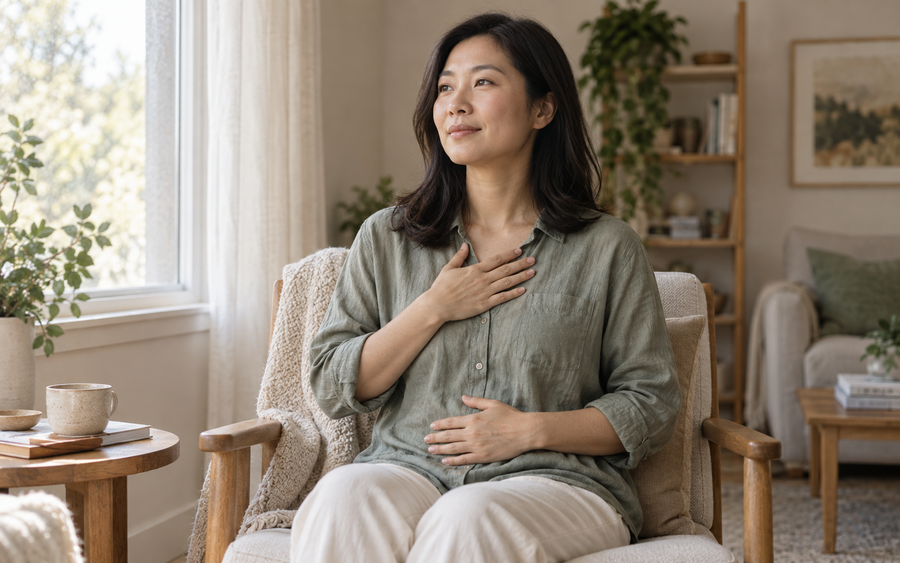
Find a comfortable position. You can sit in a chair that supports your back, with both feet flat on the floor. Or lie down on a bed or mat with your knees bent and feet flat. Loosen any tight clothing. Place one hand on your belly, just below your rib cage. Relax your shoulders and jaw.
Breathe in gently through your nose. Let your belly move without forcing it. Do not try to take a huge gulp of air. If counting helps, count comfortably as you breathe in. It is fine if you do not reach five.
Let the breath out gently through your mouth. Allow your belly to settle as you breathe out. Use a comfortable count if you want to, without stretching the breath beyond what feels easy.
Continue for a few minutes if it feels comfortable. If counting makes you more anxious, stop counting. If the exercise increases dizziness or breathlessness, pause and return to your usual breathing.
The NHS suggests practicing regularly as part of a daily routine. Trying it while you are calm can help you learn the steps and notice whether the exercise suits you.
The longer exhale pattern
A slightly longer out-breath is another pattern some people find comfortable. You can try it, but it is not a requirement for breathing exercises to be useful. Balban et al., 2023: Structured respiration trial Fincham et al., 2023: Breathwork meta-analysis
For example, you might breathe in for two comfortable counts and out for three. Treat the numbers as a guide, not a target. Drop the count if it makes breathing feel strained.
Equal counts on the in-breath and out-breath are also an option. If you feel lightheaded, stop the exercise and let your breathing settle into its usual pattern. Seek medical advice if symptoms are new, severe or not settling.
Box breathing
Box breathing, also called square breathing, uses four equal phases. Its structure gives you a simple sequence to follow. Cleveland Clinic: Box breathing
Breathe in for four counts, pause for four, breathe out for four, and pause for four before starting again. Keep each phase comfortable. You do not need to squeeze all the air out or complete a set number of rounds.
The holds in box breathing can feel challenging during a panic attack. If holding your breath increases your anxiety, skip the holds and stick with slow belly breathing instead. The technique should never feel like a struggle.
The 4-7-8 technique
The 4-7-8 technique uses a four-count inhale, a seven-count pause and an eight-count exhale. It includes a longer breath hold, which may not feel comfortable during panic. Cleveland Clinic: 4-7-8 breathing
To try it when you feel settled, rest the tip of your tongue behind your upper front teeth. Breathe in through your nose for four counts, pause for seven, and let the breath out gently through your mouth for eight. The out-breath may make a soft whooshing sound. Do not strain to reach the counts.
This is an optional relaxation exercise, not a proven way to stop an acute panic attack. If the hold feels demanding or makes you feel worse, stop and use a comfortable breathing rhythm without pauses.
Rectangular breathing
Rectangular breathing is a visual technique that combines breath control with a simple grounding task. Kent Community Health NHS Foundation Trust: Panic attacks
Look for a window, picture frame or another rectangle. Follow its outline with your eyes, breathing in along a shorter edge and out along a longer one. Let your breathing stay comfortable rather than trying to keep up with an exact pace.
You can count if it helps, or simply follow the shape. If coordinating your eyes and breathing feels like too much work, choose something simpler.
The calming hand technique
Kent Community Health NHS Foundation Trust describes a calming hand exercise in its guidance for panic and breathlessness. Your fingers serve as reminders for a short sequence. Kent Community Health NHS Foundation Trust: Panic attacks
The sequence starts with your thumb as a reminder to recognize what is happening. Your index finger cues two gentle sighs and relaxed shoulders. The middle finger cues an easy breath in, the ring finger an easy breath out, and the little finger a relaxed hand stretch. If a healthcare professional has taught you this technique, follow their guidance and keep the breaths unforced.
If you like having a physical reminder of the steps, this may be a useful sequence to discuss with your clinician.
What to avoid during a panic attack
Not all breathing patterns are helpful during a panic attack. Some can make symptoms worse.
Avoid repeated large or forceful breaths. Overbreathing can contribute to dizziness, tingling and chest or breathing discomfort. Those symptoms can also have other causes, so do not assume a breathing pattern explains new or severe symptoms. MedlinePlus: Hyperventilation
Avoid holding your breath for long periods if that feels uncomfortable. Some techniques include breath holds, but if holding makes you feel worse, skip that part.
Avoid forcing your breathing into a pattern that feels unnatural. The goal is gentle, relaxed breathing, not perfect technique. If counting distracts you, stop counting. If breathing through your mouth feels better than your nose, use your mouth.
Grounding exercises to pair with breathing
You can try grounding alongside breathing if you find it helpful. Noticing your surroundings is also an option when focusing on your breath feels uncomfortable. NHS inform: Grounding exercises
One version of 5-4-3-2-1 uses five things you can see, four you can feel, three you can hear, two you can smell, and one you can taste. If that feels like too much, focus on one ordinary object, such as your sleeve or a smooth stone. Notice its texture without seeking an intense or painful sensation.
You can also name things around you that start with A, B and C, then continue if you want to. Skip a letter if it becomes frustrating. There is no need to finish the alphabet.
If these are familiar symptoms that have been assessed as panic, use the reminders in your coping plan. You do not need to make yourself calm immediately.
When to seek medical help
Breathing exercises can be useful coping tools, but they do not suit everyone and cannot replace medical assessment. NCCIH: Anxiety and complementary approaches Banushi et al., 2023: Breathwork in clinically diagnosed anxiety
Get emergency help for new or severe chest pain, severe shortness of breath, collapse or fainting with ongoing symptoms. Seek prompt assessment for a first episode or symptoms that are unexplained or different from your usual pattern. NHS: Heart attack Mayo Clinic: Panic attacks and panic disorder
Panic attacks can feel like a heart attack or a respiratory emergency. If you are unsure whether your symptoms are panic or something else, it is always better to get checked.
How to build a daily practice
The NHS suggests practicing its gentle breathing exercise regularly and continuing for at least five minutes when comfortable. You could set aside a quiet moment in the morning or before bed. Start with what feels manageable. NHS: Breathing exercises for stress
Practicing while calm gives you a chance to learn the steps and notice your preferences. You might prefer gentle belly breathing, a counted pattern or a visual reminder. There is no need to use every method.
Write down the technique that works best for you so you have a quick reminder when you need it. Keep it simple. One or two sentences is enough.
Practice guided breathing with Rootd
Rootd includes guided breathing exercises you can explore as part of your routine. Its visualizations offer another option when you want a different point of focus. Explore Rootd and find a tool you feel comfortable practicing. Rootd: Official Google Play listing
The bottom line
Keep breathing gentle and comfortable. You do not need a longer exhale, perfectly still chest or exact count. Try a technique when you are calm, pair it with grounding if you like, and stop if it makes you feel worse. New or severe symptoms need medical assessment.
You do not need to master every technique. Start with one manageable option, and seek professional support if panic keeps returning or disrupts your life.